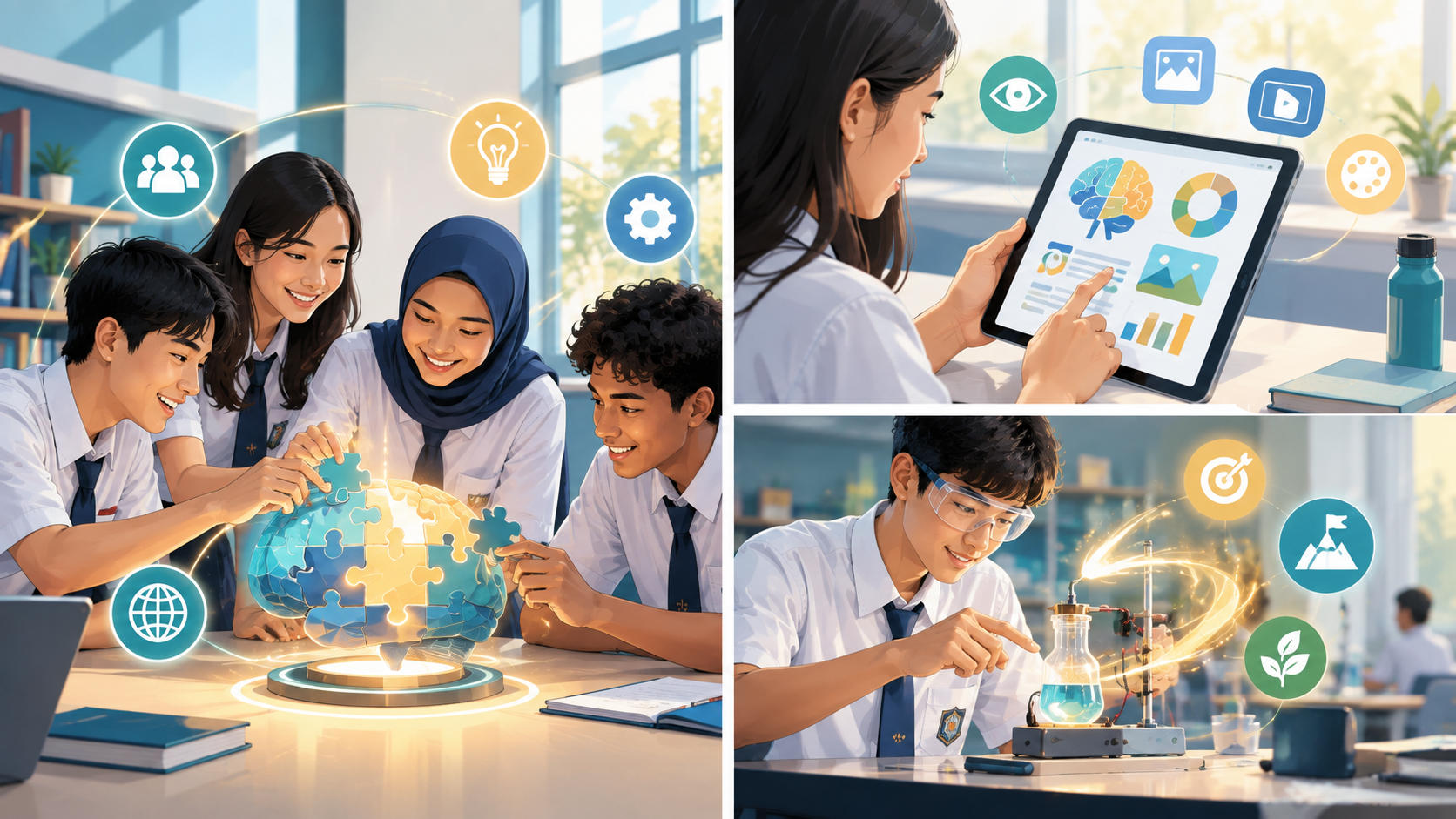
A. The Evolution of Learning Preferences and Classroom Practices
In the ongoing pursuit of educational excellence, understanding how students absorb, process, and retain information has remained a central focus of educational psychology. For decades, classroom instruction has been heavily influenced by sensory modality frameworks, most notably the VARK (Visual, Auditory, Reading/Writing, and Kinesthetic) model developed by Neil Fleming. According to this classic paradigm, visual learners process information best through shapes, diagrams, and symbolic representations; auditory learners excel through spoken explanations and verbal repetition; reading and writing learners depend heavily on written words; and kinesthetic learners thrive through tactile experiences and direct physical involvement.
Despite the intuitive appeal of categorizing students into these distinct learning styles, modern educational realities demand a more nuanced, evidence-based approach. Traditional pedagogy has frequently suffered from a critical mismatch, where educators rely extensively on passive lecturing, thereby alienating active, visual, or kinesthetic learners and contributing to disengagement or uneven academic achievement. However, recent scholarship suggests that cognitive styles are far more fluid, often following multi-dimensional patterns that span social, individual, situational, and habitual dimensions. As educators work to optimize instructional quality, understanding how these diverse learning preferences interact with student motivation is essential. Motivation—the internal and external forces that drive individuals to initiate, sustain, and direct their learning behaviors—serves as the engine of academic success. Therefore, exploring the alignment between student motivation and learning preferences is critical to designing inclusive, responsive classrooms.
B. Decoupling Sensory Modalities, Motivation, and Academic Outcomes
a. The Sensory Modality-Performance Connection
Empirical research confirms that utilizing dominant learning styles can positively influence academic performance, though the strength of this relationship varies considerably depending on the educational context. In a correlational study involving senior high school students in Surabaya, researchers identified statistically significant, positive relationships between academic performance and all three primary sensory learning styles. Specifically, the visual learning style displayed the strongest positive correlation with learning outcomes, followed closely by kinesthetic and auditory modalities, indicating that students who effectively leverage their dominant sensory preferences tend to achieve higher academic standings. These findings suggest that aligning instructional media with students' cognitive profiles reduces cognitive load, structures complex patterns, and strengthens memory retention.
However, this direct relationship is not universally strong. For instance, a larger study of elementary school students in Palu observed that while a moderate-to-strong positive correlation existed between learning motivation and science outcomes, the correlation between learning styles and academic outcomes was comparatively weak. When the variables of motivation and learning style were analyzed collectively, they exhibited a very weak, non-significant correlation with academic performance, suggesting that these factors interact in complex, non-linear ways rather than as a simple additive determinant.
b. The Independence of Motivation and Modality
Crucially, empirical evidence demonstrates that a student's sensory learning style is statistically independent of their intrinsic drive or self-motivation. A comprehensive survey of high school students in Cebu revealed that while the cohort exhibited high baseline self-motivation—particularly characterized by an overwhelming willingness to acquire new skills and a high receptivity to positive peer feedback—there was no statistically significant relationship between their motivation levels and their learning styles. This independence indicates that a student's desire to achieve and excel is decoupled from their sensory preferences; a highly motivated student will adapt and seek strategies across multiple modalities to achieve their goals, while low motivation cannot be solved simply by matching instruction to a preferred style.
This independence of motivation and modality is further corroborated by research in Cirebon examining elementary students under a Problem-Based Learning (PBL) framework. The study concluded that motivation scores did not significantly differ among visual, auditory, or kinesthetic learners, demonstrating that active, contextualized instruction can successfully engage and motivate students regardless of their underlying sensory profiles. When an active learning model like PBL is deployed, it naturally accommodates multiple modalities—offering visual cues through real-world problems, auditory opportunities through collaborative discussions, and kinesthetic engagement through active problem-solving—which levels the motivational playing field.
c. Embracing Multimodality and Cognitive Flexibility
Rather than fitting neatly into isolated sensory boxes, students frequently exhibit hybrid or multimodal preferences. In a study of English Language Education students in Singaraja, nearly half of the cohort preferred a visual style, while a significant portion preferred kinesthetic or auditory styles, and several students exhibited multimodal visual-kinesthetic and visual-auditory styles. Interestingly, visual-kinesthetic learners were found to actively employ text intertextuality—reading multiple related sources to resolve ambiguous concepts and decode complex ideas—especially when navigating difficult tasks such as identifying implied main ideas, parsing deductive arguments, or detecting logical fallacies.
This fluidity supports the multidimensional framework proposed by Madhu and Bhattacharyya (2023), which categorizes learners along a two-dimensional grid of approaches (social vs. individual) and perspectives (situational vs. habitual). This grid maps students into four distinct quadrants:
- Self-supportive learners (habitual-individual): Independent, self-directed, and reliant on personal routines in quiet setups.
- Contextual learners (individual-situational): Comforted by familiar environments where they can control their learning pace.
- Associative learners (situational-social): Highly reliant on structured environments, expert guidance, and logical sequencing.
- Collaborative learners (social-habitual): Thriving in peer-group activities, reciprocal interactions, and shared learning dynamics.
This rich diversity demonstrates that a complex web of supporting factors shapes academic success. As summarized in the high school studies in Surabaya, student performance is ultimately determined by the dynamic interaction of physical health (physiological), self-esteem and attitude (psychological), parental involvement (family environment), classroom climate and school facilities (school environment), positive peer influence (community environment), and effective time management.
C. Implications for Differentiated and Responsive Pedagogy
The synthesis of these empirical findings yields vital implications for educational policy and daily teaching practices. First, the statistical independence of learning styles and self-motivation suggests that the historic practice of profiling and teaching to a single, rigid sensory modality is a pedagogical oversimplification. Labeling a student as strictly "visual" or "auditory" limits their cognitive adaptability and fails to address their underlying motivational and environmental needs.
Instead, the path forward lies in multimodal differentiated instruction and the creation of inclusive, active learning environments. Rather than abandoning learning style theory, teachers should integrate a wide variety of instructional strategies within every lesson. Visual media (such as concept maps and diagrams), auditory activities (including group debates and collaborative dialogue), and kinesthetic tasks (such as experiments and hands-on simulations) should be woven together to provide multiple entry points for all learners. Furthermore, utilizing active learning models like Problem-Based Learning (PBL) can naturally bridge these differences, elevating intrinsic motivation and academic engagement across diverse student profiles. By addressing both individual cognitive differences and environmental supporting factors, educators can foster a highly motivating, resilient, and equitable academic culture.
forum Discussion
No discussions yet. Be the first!