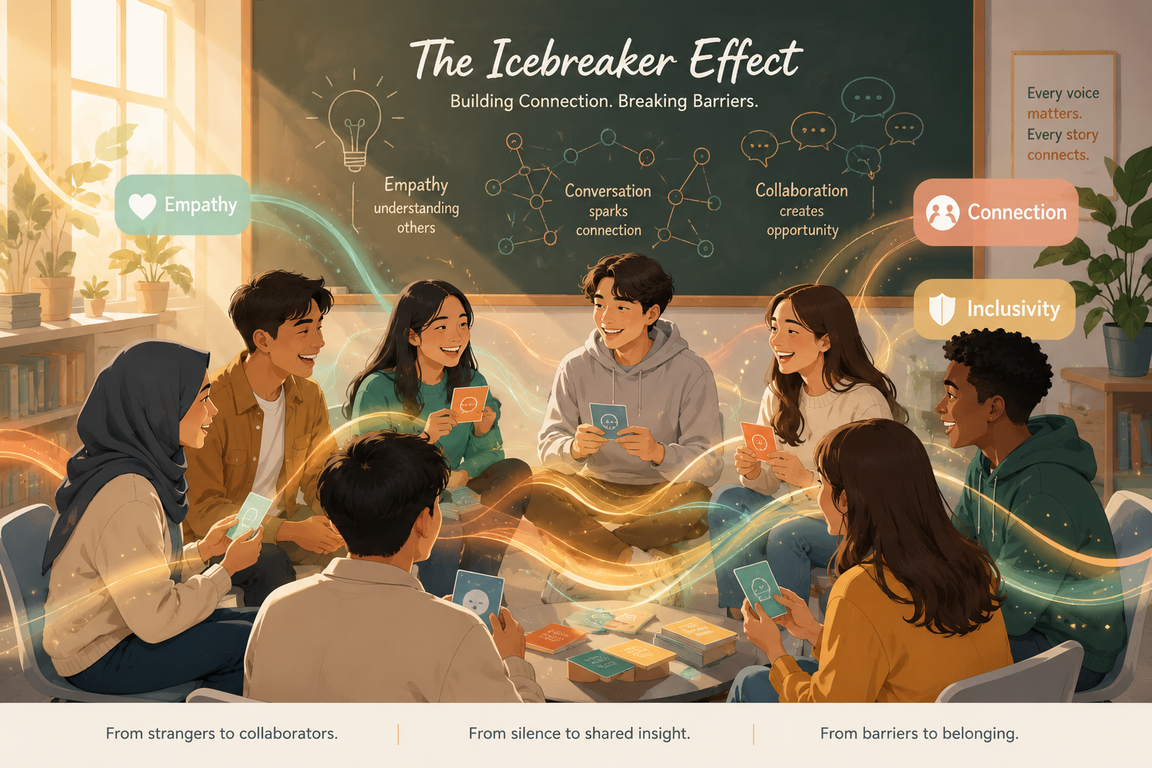
A. The First Few Minutes
The first few minutes of any class can often be tense and anxiety-inducing for both teachers and students. In a traditional classroom setting, students frequently enter carrying psychological barriers—ranging from social anxiety and peer discomfort to general academic fatigue. These initial feelings of discomfort can severely hinder a student's readiness to learn, leading to passive classroom environments where collaboration is minimal and disengagement is high.
To combat this, the use of icebreaker activities has become a ubiquitous strategy in modern education. Broadly defined as low-stakes, non-threatening activities designed to introduce students to one another and the teacher, icebreakers are celebrated for their ability to build rapport and foster a positive learning environment. A positive classroom climate is not merely a "nice-to-have" luxury; educational research consistently demonstrates that it directly leads to increased student engagement, heightened motivation, and better academic outcomes.
However, as educational approaches evolve under frameworks like the Independent Curriculum (Kurikulum Merdeka), which prioritizes flexible, student-centered, and enjoyable learning, educators must look past the superficial appeal of these activities. How do icebreakers actually transform classroom behaviors? What does the empirical data tell us about their limitations? By analyzing recent quantitative and qualitative research, this article explores the science behind icebreakers and offers actionable strategies to turn standard warm-ups into meaningful cognitive bridges.
B. The Empirical Evidence: Conceptual Shifts and Real Classroom Transformations
To understand the real-world impact of icebreakers, we must look beyond abstract theories and observe the actual transformations that occur within school walls. Evidence from diverse classrooms shows that these short activities can trigger profound behavioral shifts, turning silent, disconnected rooms into active communities of learning.
C. Breaking Isolation in Toledo High School
A mixed-methods study conducted over a full semester in a senior high school department in Toledo City, Philippines, offers a clear picture of this transition. Researchers set up a comparative observation between two classrooms: one that consistently utilized icebreaker activities and a control classroom that did not.
In the non-icebreaker classroom, the atmosphere remained flat and passive. Students who entered the room without knowing their peers reported feeling intensely nervous, which built a psychological barrier that made them hesitant to participate in discussions. Throughout the semester, this group stayed relatively closed off, with minimal peer interaction.
In contrast, the classroom that experienced regular icebreakers underwent a complete social evolution. Activities like light cooperative games broke down initial social anxieties and assumed the risk of vulnerability for the students. Students in this cohort reported feeling significantly more at ease, which directly translated into an increased willingness to speak up, ask questions, and collaborate. Interestingly, the sense of community forged during these opening minutes was so strong that it spilled out of the classroom; students who participated in icebreakers were far more likely to help each other with academic work and even form genuine friendships outside of school hours.
D. Tactical Implementation: Game-Based Approaches and "Connection Before Content"
To maximize the cognitive utility of icebreakers, teachers should look toward two main strategies: diversifying game-based activities and applying the rule of "connection before content".
1. Integrating Digital and Non-Digital Games
An observational study of elementary school teachers in Malang highlighted how combining digital and non-digital games can keep students highly motivated:
- Non-Digital Games: Activities like "Look and Match" worksheets, group-based "Listen and Stick It" running games, or competitive "Like or Doesn't Like" phrase-building games on the whiteboard require minimal technology but spark intense collaboration, physical movement, and vocabulary retention.
- Digital Games: Utilizing classroom projectors and laptops to run gamified platforms such as Wordwall picture quizzes, Eduplay interactive worksheets, or time-limited Educandy quizzes provides instant, engaging feedback.
However, implementing these games is not without challenges. Teachers frequently cite obstacles such as the time-consuming nature of game preparation, managing student behavior when excitement gets too noisy, limited physical classroom space, power outages, and a lack of digital devices for everyone to play simultaneously.
2. Transitioning to "Connection Before Content"
To overcome preparation fatigue and ensure icebreakers actually support academic focus, educators can adopt a concept championed by facilitation expert Chad Littlefield: ditch the word "icebreaker" and replace it with "connection before content".
The philosophy is simple: any opening activity must connect directly to the purpose of why the students are there in the first place. If an activity feels completely irrelevant to the subject, students (especially mature learners or high schoolers) may view it as childish or distracting.
To build seamless, low-risk, and meaningful transitions, educators can utilize several tested, highly flexible formats:
- The "Looking Forward To" List: Give students 30 seconds to mentally list or write down three things they are looking forward to in the course or near future. Have them share in groups of three, requiring peers to ask at least one follow-up question. This honors introverts by giving them time to think, builds mutual interest, and removes social risk.
- The Question Swap: Hand out cards with pre-written questions that are color-coded by depth (e.g., green for light and fun, purple for self-reflection, blue for deeper values). Students pair up, ask each other their card's question, swap cards, raise their hands to find a new partner, and repeat. This allows complete self-paced flexibility and keeps the energy high.
- The "To Be vs. To Do" List: A highly reflective writing exercise where students spend three minutes journaling two lists: first, what they want to do during the semester/year; second, who they want to be (e.g., compassionate, focused, resilient) while doing those things. Sharing these value-centric lists instantly elevates peer conversations to a deeply personal and supportive level.
E. Designing the Warm Classroom
Icebreakers are not merely frivolous games or time-fillers to be squeezed into a lesson plan; they are humanistic tools that validate students as active, social beings who need to feel safe, valued, and emotionally ready to learn. While icebreakers may not directly teach complex grammar or mathematical equations, they build the vital social infrastructure—the trust, the safety, and the rapport—that makes academic mastery possible. By thoughtfully selecting age-appropriate designs, balancing digital and non-digital tools, and carefully aligning activities with lesson themes through "connection before content," educators can transform those initial, anxious minutes of class into an inspiring launchpad for lifelong learning.
forum Discussion
No discussions yet. Be the first!