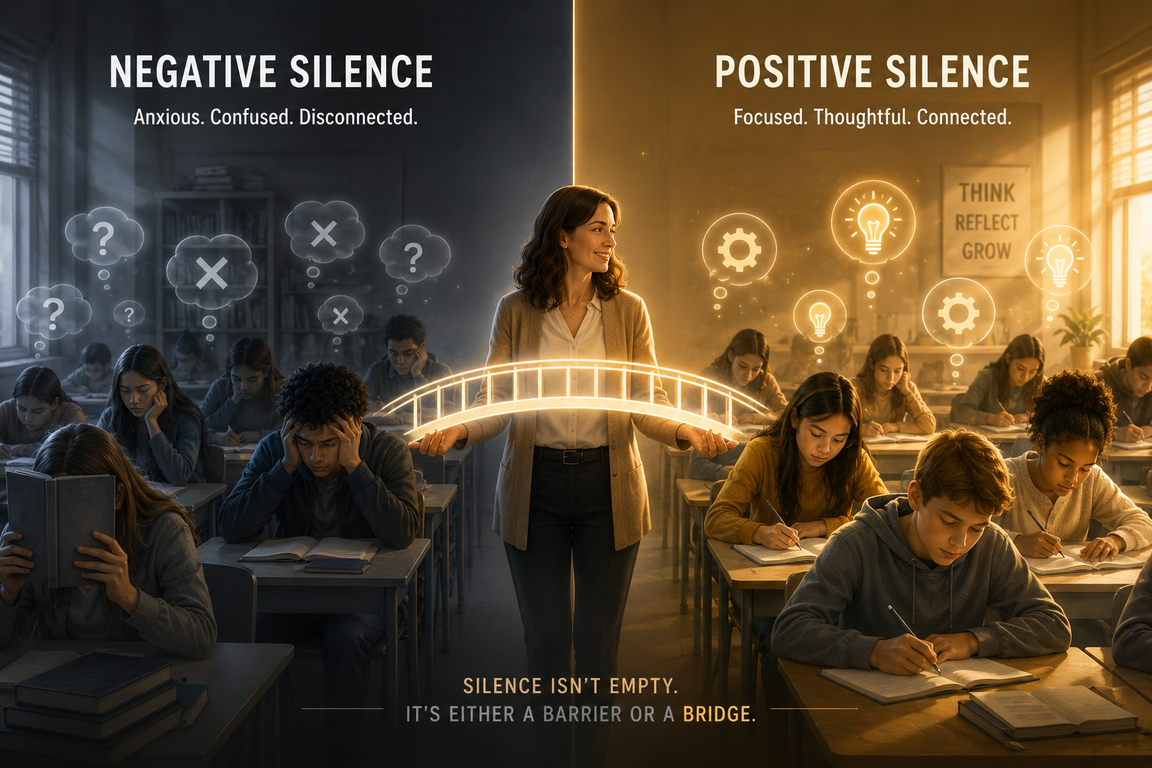
As educators, we’ve all been there: you ask a thought-provoking question, and... nothing. Just a sea of quiet faces. For many of us, that silence sets off alarm bells, making us wonder if our lesson has failed or if our students are simply checked out. But here’s the secret: not all silence is created equal.
To build a truly engaged classroom, we have to become "silence detectives." We need to recognize when the quiet is a wall blocking learning and when it’s a bridge to deeper understanding.
The Meaning of the Silence: Is it a Wall or a Bridge?
In our blog today, let's look at the two sides of the coin.
1. The Negative Silence (The Wall)
This is the kind of silence that hinders growth and communication. It usually stems from:
- Fear and Anxiety: Students are often terrified of making mistakes, being judged by us, or—worse—being laughed at by their peers.
- Confusion and Boredom: Sometimes they’ve simply "mentally checked out" or are so lost they don't even know what to ask.
- The "Armor" of Silence: Especially after years of online learning or passive "indoctrination" styles of teaching, students might use silence as a habit or even "armor" to avoid the vulnerability of speaking up.
- Low Self-Esteem: Many students feel their English (or subject knowledge) isn't "clever" enough compared to their peers, so they choose to stay invisible.

2. The Positive Silence (The Bridge)
This is the "good" quiet—the kind we actually want to see more of:
- Deep Thinking: This is when students are processing, connecting ideas, and reflecting. It is the only silence that indicates real, active learning.
- Self-Regulation: Silence can prompt students to turn inward and process information independently at their own pace.
- Purposeful Focus: Techniques like "Golden Silence" allow students to become fully immersed in a task without the distraction of "teacher talk".
How to Overcome the Negative Silence
If your classroom feels stuck in a "vicious circle" where students are afraid to speak and you’re losing the enthusiasm to teach, it’s time to shake things up.
- Be a "Safe" Role Model: Students often see us as the ultimate authority. By being a friendly, approachable teacher and showing that it's okay to make mistakes, we lower the "threat level" of the room.
- The Power of Groups: Many students find it easier to speak in small teams. In a group, a mistake isn't "too obvious," and the pressure is shared.
- Ditch the Textbook (Sometimes): Monotone lessons lead to monotone silence. Try game-based learning, role-plays, or songs to make participation feel like fun rather than a test.
- Wait for It: Give them "wait time." Sometimes we jump in too quickly to fill the silence, but students often just need a few seconds to organize their thoughts before they feel brave enough to speak.
How to Increase the Positive Silence
We don't want a noisy classroom all the time; we want a purposeful one. Here is how to nurture the "good" quiet:
- The "Silent Entry": Start your class in silence to set a calm, safe tone for the day.
- The "Silent Teacher" Method: Try modeling a task in complete silence. This forces students to focus on your actions rather than trying to process your voice at the same time.
- Golden Silence: Once the room is quiet for a task, wait a few extra seconds. This allows for that "golden" moment where students truly sink into their "deep work".
- Use Visual Indicators: Use non-verbal gestures to maintain the quiet so you don't have to raise your voice and break the students' concentration.
The Bottom Line
Our goal isn't just a quiet classroom; it's a truly engaged one. A healthy classroom is flexible—it can move from a buzzing discussion to a deep, reflective silence and back again without resistance. By listening to the "voices" behind the silence, we can create a space where every student feels safe enough to speak and quiet enough to think.
forum Discussion
No discussions yet. Be the first!